United Nations Development Programme (UNDP) Akassa LGA Space Initiative for Sustainable Development, Peacebuilding, Community Empowerment, and Economic Advancement Across Opu Akaha and the Entire Akassa Clan
The Akassa Clan in Bayelsa State stands as one of the historically significant coastal regions within the Niger Delta, richly blessed with natural resources, aquatic livelihoods, cultural heritage, and resilient communities whose contributions to regional stability and economic activity continue to shape the identity of the region. Over the years, the people of Opu Akaha and the wider Akassa Clan have maintained strong communal values rooted in peacebuilding, cooperation, environmental stewardship, and collective development aspirations despite the numerous environmental, infrastructural, and socio-economic challenges confronting riverine communities across the Niger Delta.
The emergence of the United Nations Development Programme (UNDP) Akassa LGA Space Initiative represents a strategic developmental vision designed to promote inclusive growth, strengthen local participation in governance and development planning, and encourage sustainable partnerships capable of transforming Opu Akaha and the entire Akassa Clan into a model of community-driven advancement within Bayelsa State and Nigeria as a whole.
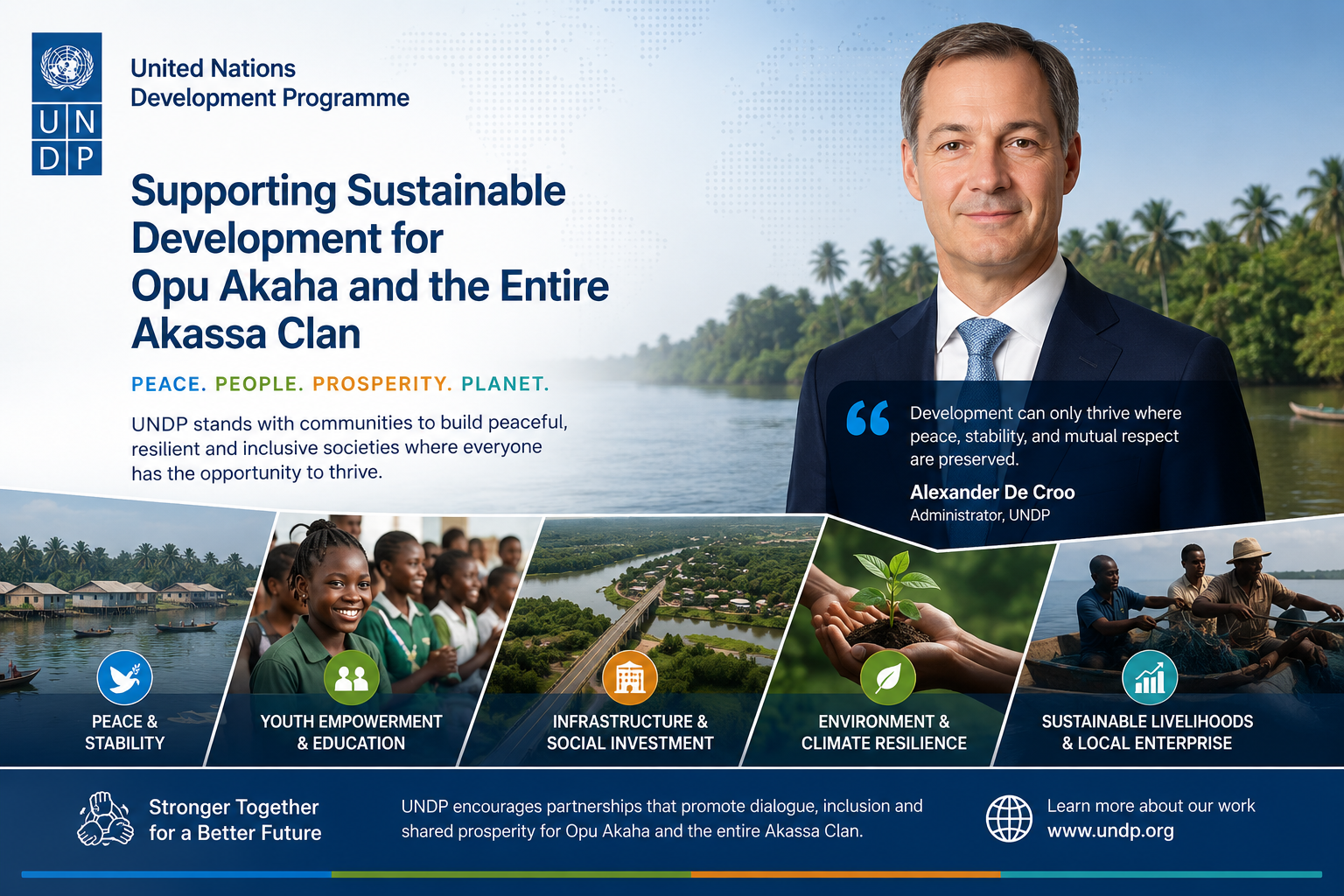
This initiative seeks to encourage broad-based development through coordinated investments in infrastructure, education, healthcare access, youth empowerment, environmental sustainability, economic diversification, community enterprise, and social inclusion. The vision behind the project is anchored on the understanding that meaningful development can only thrive in an atmosphere of peace, stability, mutual respect, and transparent stakeholder collaboration.
Historically, the Akassa region has played an important role within the Niger Delta due to its strategic coastal location, maritime heritage, fishing economy, and longstanding communal institutions. The people of the area continue to demonstrate resilience and determination toward building stronger communities capable of attracting opportunities for future generations. However, like many riverine communities, the region continues to face challenges associated with environmental vulnerability, climate change, limited infrastructure, youth unemployment, inadequate institutional presence, and restricted access to sustainable economic opportunities.
The proposed development framework under the UNDP Akassa LGA Space Initiative therefore aims to support pathways capable of addressing these developmental gaps while preserving the environmental and cultural identity of the people. Particular emphasis is placed on climate resilience, environmental restoration, peacebuilding mechanisms, and community-centered economic development that empowers local residents while promoting sustainable resource management.
One of the major priorities of the initiative is youth empowerment and human capital development. Young people remain the backbone of community advancement, and sustainable progress cannot be achieved without creating opportunities that enable them to contribute productively to society. Through skills development programmes, entrepreneurship support, educational advancement, digital innovation opportunities, and vocational initiatives, the project seeks to inspire a new generation of community leaders and development participants across Opu Akaha and the wider Akassa Clan.
Infrastructure development also remains central to the long-term vision of the initiative. Improved access to transportation systems, educational facilities, healthcare services, water resources, communication networks, and environmentally sustainable community infrastructure will significantly enhance the quality of life for residents while encouraging local economic growth and regional integration.
In addition, the initiative recognizes the importance of preserving peace and strengthening relationships among neighboring communities throughout the Akassa region. Sustainable development cannot flourish where instability, distrust, or communal conflict exists. Therefore, dialogue, reconciliation, community participation, and inclusive governance remain essential pillars of the broader development agenda envisioned for the area.
The involvement of responsible private sector organizations, development partners, traditional institutions, civil society organizations, and government stakeholders will be critical toward ensuring the successful implementation of projects capable of delivering measurable and lasting impact for the people of Akassa Clan. Collaborative partnerships remain necessary in mobilizing resources, technical expertise, innovation, and institutional support needed to unlock the enormous developmental potential of the region.
As global conversations continue to focus on sustainable development, environmental responsibility, poverty reduction, and inclusive economic transformation, the Akassa Clan possesses significant opportunities to emerge as a strategic example of how local communities can leverage peace, partnership, and resilience to achieve meaningful progress within the Niger Delta.
The United Nations Development Programme continues to support initiatives that prioritize human dignity, sustainable livelihoods, environmental responsibility, and inclusive prosperity for vulnerable communities around the world. The Akassa LGA Space Initiative reflects these principles by encouraging a future where the people of Opu Akaha and the entire Akassa Clan can thrive socially, economically, environmentally, and institutionally for generations to come.
Through unity, partnership, visionary leadership, and sustained community participation, the future of Akassa Clan holds tremendous promise as a center for peace, sustainable growth, regional cooperation, and transformative development within Bayelsa State and beyond.